
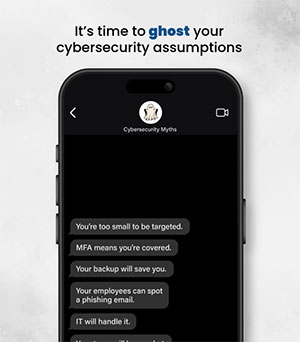
 October is Cybersecurity Awareness Month, which makes it a good time to ask a question that is more important than how many security products your company owns:[1]
How much do you actually know about what is protecting your business?
Most business leaders are not trying to become cybersecurity experts. You have employees to lead, customers to serve, numbers to watch, and a company to run. You hired people to handle technology because you should not have to personally investigate every backup, login attempt, security alert, or software update.
The problem starts when that delegation creates confidence without enough visibility.
Everything seems handled until an insurance questionnaire asks a question nobody can answer. An employee receives a convincing phishing message. A backup needs to be restored. An account is compromised. Suddenly, something you thought was covered is back on your desk.
Here are six assumptions worth challenging before that happens.
Myth 1: We are too small for cybercriminals to care about
Cybercriminals do not need your company to be famous. They need an opportunity.
If your business has email accounts, financial information, customer data, employee information, banking access, or connections to other companies, there is something worth protecting.
The better question is not whether someone specifically wants to attack your company. It is whether an exposed account, weak password, vulnerable device, or convincing email could give someone an opening.
The truth: Being smaller does not make an exposed system invisible.
Myth 2: Our employees will recognize a phishing email
There was a time when scam emails were easier to spot. Bad spelling, awkward language, strange formatting, and obvious requests gave employees clues.
That is becoming less reliable.
Today’s fraudulent messages can sound polished and familiar. They can reference real people, imitate normal business conversations, and arrive when someone is busy enough to act before thinking.
Instead of asking employees to become expert scam detectors, give them a simple process.
- Would this person normally make this request?
- Why did the payment instructions suddenly change?
- Why is someone asking for sensitive information this way?
- Is there another way to verify the request before acting?
The truth: Your people do not need perfect instincts. They need a clear next step when something feels wrong.
Myth 3: MFA means our accounts are covered
MFA is an important protection, but no single security control should carry the weight of your entire strategy.
Employees can still receive fraudulent approval requests. Authentication methods can still be targeted. People can still make mistakes when they are distracted or rushed.
The more important question is whether MFA is part of a coordinated approach that includes appropriate access controls, monitoring, employee guidance, and someone responsible for responding when something suspicious happens.
The truth: MFA is an important layer, not permission to stop paying attention.
Myth 4: We have backups, so we can recover
Having backups and being able to recover your business are not the same thing.
Imagine your systems become unavailable tomorrow morning.
- How quickly can the right data be restored?
- Has anyone tested the process?
- Which systems come back first?
- Who makes those decisions?
- What happens while employees wait?
A backup becomes valuable when you know it works and understand what recovery actually looks like.
Otherwise, you may discover the answer at the worst possible moment.
The truth: The time to learn whether your recovery plan works is before you need it.
Myth 5: Cybersecurity is IT’s responsibility
Your technology provider can put protections in place, but security decisions happen throughout your company.
- Someone receives an unusual payment request.
- Someone is asked to reset a password.
- Someone gets a strange MFA prompt.
- Someone pastes information into an unapproved tool.
- Someone clicks something and has to decide whether to report it.
Technology can reduce risk, but people still need to know what to do.
Leadership matters here too. Employees notice whether managers follow verification procedures, whether questions are welcomed, and whether mistakes are reported quickly or hidden because someone is afraid of being blamed.
The truth: Good cybersecurity gives employees a role they can actually understand and follow.
Myth 6: We know what to do if something happens
This is one of the most dangerous assumptions because it often survives right up until the incident begins.
Then the questions start.
- Who calls the IT provider?
- Should employees shut anything down?
- How do we communicate if normal systems are unavailable?
- Who contacts the insurance company?
- Who talks to customers?
- Who has authority to make decisions?
You do not want your incident response plan being invented in the middle of the incident.
The truth: When the pressure is high, people should be following a plan, not trying to remember what someone once told them.
The bigger cybersecurity question
Most leaders do not want another security product simply because another security product exists.
- They want to know someone is looking at the whole picture.
- They want fewer moments when they discover a problem after the fact.
- They want recommendations before something becomes an emergency.
- They want to understand what matters without having to become the company’s cybersecurity expert.
In other words, they want to be able to say:
“We’ve got people we trust handling this.”
That is what proactive cybersecurity should create.
If you are not sure which assumptions your current security strategy is relying on, schedule a 10 minute discovery call with Diamond Technologies.
We can look at where responsibility is clear, where uncertainty remains, and where something you assume is covered may deserve a closer look.
Call 302-656-6050 or visit our Contact Us page to schedule a conversation.
Frequently Asked Questions
Is my business too small to be targeted by cybercriminals?
No. Cybercriminals look for an opportunity, not a specific target. Any business with email accounts, financial information, customer data, or banking access has something worth protecting, regardless of company size.
Can employees reliably spot phishing emails on their own?
Increasingly, no. Fraudulent messages can be polished, reference real people, and imitate normal business conversations. A clear verification process, rather than relying on employees to spot errors, is the more reliable safeguard.
Does multi factor authentication mean our accounts are fully protected?
No. MFA is an important layer of protection, but it should be part of a coordinated approach that includes access controls, monitoring, and employee guidance, not the entire security strategy on its own.
If we have backups, does that mean we can recover from an incident?
Not necessarily. Having backups and being able to recover quickly are different things. A backup only becomes valuable once it has been tested and the recovery process is understood in advance.
Is cybersecurity solely the IT department's responsibility?
No. Technology reduces risk, but employees across a business make security relevant decisions daily, such as verifying a payment request or reporting a suspicious message. Ownership needs to extend beyond IT.
What should a business do if it doesn't have a documented incident response plan?
It should work with its IT provider to build one before an incident occurs. Decisions made under pressure during an actual incident are far less reliable than a plan established and agreed on in advance.