
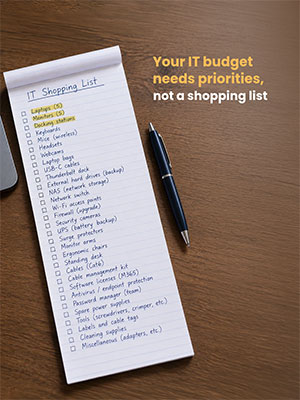
 To prioritize a 2027 IT budget, compare three things: what happens if a request waits, which expenses already have a date attached, and which changes your business expects in 2027. Then give each item a next step: address now, schedule next, or review later.
When every technology request arrives marked “important,” deciding what to fund can feel like choosing between several reasonable answers. Your team wants a better business application. Some computers need attention. A renewal is approaching. A security recommendation is waiting for a decision.
All of those may deserve a place in the plan. They don’t necessarily deserve the same deadline. These three questions make them easier to sort.
1. What happens if we wait?
Start with the business consequence, not the age of the equipment or how long a request has been sitting in someone’s inbox. An older computer that remains reliable and supported is a different decision from a recurring system problem that keeps employees from finishing their work.
Consider a Wilmington professional services firm choosing between a cosmetic software upgrade and a fix for repeated problems opening client files. Both might improve the working day. One is more directly tied to delivering the work clients are paying for.
Ask your IT provider to explain what delaying a recommendation would mean:
- Who would be affected?
- How often does the problem occur?
- Is there an unresolved security concern?
- Is there a reasonable temporary measure, or would waiting leave the business exposed to an unacceptable risk?
You don’t need a dramatic worst-case scenario. You need an understandable explanation of the tradeoff.
2. Which expenses already have a date attached?
Some decisions feel urgent because they weren’t placed on the calendar early enough. Software renewals, planned hiring, office moves, and scheduled projects all give you dates to work backward from.
For each known expense, record three dates:
- When a decision is needed
- When work must begin
- When the money is likely to be spent
Those may be three different dates. A system needed in April may require planning and setup earlier. A contract renewing in June may have an earlier deadline for changes. New employees need working tools when they start, not after their first week.
Published vendor dates show how this works in practice. Microsoft’s extended support for Windows Server 2016 ends on January 12, 2027, and Extended Security Updates for Windows 10 cost businesses more each year, with the price doubling annually. Dates like those belong on the calendar before they become urgent.
Separating recurring costs from one-time purchases also makes the conversation clearer. You can see what changes the ongoing budget and what needs a specific project allocation. The point is not to make the planning document more complicated. It is to stop treating scheduled expenses as unexpected ones.
3. What is changing about how the business works?
Your technology priorities should reflect your operating plans. Imagine a company with a Wilmington office adding a team in southern New Jersey. Beyond the new equipment, there are questions about shared systems, access permissions, communication, and who supports employees at each location.
A similar review belongs alongside a merger, a new service offering, or a change in how office and field teams work together. These changes can involve more coordination than a purchase alone suggests. In a published testimonial, Mark Stallard, IT Specialist at EDiS Company, describes Diamond’s help combining two Microsoft 365 environments into one and getting employees back into their accounts on the day of the switch.
Before approving a technology project, ask whether it supports a business change already in motion, and whether other work depends on it.
How do you decide what to address now, schedule next, or review later?
Once you have discussed those three questions, assign each expense to a practical category.
| Category | Use it when |
|---|---|
| Address now | The issue is disrupting important work, presents an unacceptable risk, or has a deadline you cannot reasonably move. |
| Schedule next | The need is understood, and there is time to plan the purchase, implementation, and funding. |
| Review later | Deferring the item is reasonable, provided someone owns the decision and there is a date or condition for reconsidering it. |
“Later” should mean a deliberate choice, not a permanent parking place.
Where does strategic planning fit?
Diamond Technologies, a Wilmington, Delaware managed IT services provider serving Delaware, Pennsylvania, Maryland, and New Jersey since 1996, provides managed and co-managed IT services, including regular strategic planning. That gives business leaders and internal IT teams a place to discuss priorities together.
Your 2027 budget doesn’t have to solve everything at once. It should make the next decisions clearer. For a related look at keeping reviews on a schedule, read IT Readiness Is Not a One Time Project.
Schedule a discovery call with Diamond Technologies. Call 302-656-6050, and let’s talk through what deserves attention first. You can also contact us online.
Frequently Asked Questions
How do you prioritize IT spending in a budget?
Compare the business consequence of waiting, the expenses that already have a date attached, and the changes your business expects next year. Then sort each item into one of three categories: address now, schedule next, or review later. Each item should have an owner and a next step.
What IT expenses should be funded first?
Fund first the items that are disrupting important work, present an unacceptable risk, or have a deadline you cannot reasonably move. A recurring problem that keeps employees from completing client work generally ranks above a cosmetic upgrade.
Which dates should you track for known IT expenses?
Track three dates for each known expense: when a decision is needed, when work must begin, and when the money is likely to be spent. These can differ. A contract renewing in June may have an earlier deadline for changes, and a system needed in April may need earlier planning and setup.
Is it acceptable to postpone an IT project?
Yes, if the decision is deliberate. Deferring an item is reasonable when someone owns the decision and there is a date or condition for reconsidering it. Ask your IT provider what waiting would mean, especially if the item involves an unresolved security concern.
What is co-managed IT, and how does it help with planning?
Co-managed IT means an IT provider works alongside your internal IT staff. At Diamond Technologies, co-managed services can help fill gaps and provide 24/7 coverage while your internal team focuses on its own priorities, and regular strategic planning gives both sides a place to discuss priorities together.